
 English


MAXNOVO MACHINE Tips : A level surface is very fundamental prerequisite for all CNC Lathes to do high precision machining. No matter which kind of the lathe machine type - whether CNC Lathe Machine or Metal lathe, Heavy Duty Lathe, Horizontal Turning Lathe or Vertical Lathe - Proper Leveling is important for lathe machines to achieving accurate machining.
If you skip leveling, you would end up with a taper that affects the precision of your workpieces. It would result in taper errors that compromise part geometry, leading to increased downtime, costly rework, and reduce production efficiency. In short, a misaligned lathe would have big problems on both productivity and the capability to produce high precision components.
Although the leveling process requires full attention, it is not too much complex. Our MAXNOVO MACHINE'S professional machinery experts are willing to share tips with you together. We tell the steps for leveling a lathe, help you to consistently produce precision parts while maintaining optimal workflow efficiency.
Table Of Content
1. The Importance of a Properly Leveled Lathe
2. CNC Lathe Machine Lifting
3. CNC Lathe Machine Clean and Lubrication
4. CNC Lathe Leveling
5. CNC Lathe Re-check
6. Conclusion
Before starting to level CNC lathes or Manual lathes, it is necessary to understand the principles and why we need to do level for lathes. Regardless of lathe types, leveling is performed to eliminate structural "twist" from the machine, ensuring that all axes remain mutually perpendicular. Both the static weight of the lathe and the clamping force of its mounting bolts could induce gradual shifts in the machine bed—whether during operation or periods of inactivity. These movements could cause misalign the headstock and tailstock, torsional deformations into the machine structure.
Lathe machines' operates along three axes (X-axes, Y-axes, Z-axes), they must work in concert with each other in precise coordination. Any Misalignment changes the relationship between them, it would cause one axis is more affected than the others. Please pay full attention to one important point, the "level" in this article does not necessarily imply parallelism with the ground; rather, it signifies that the lathe's three axes are correctly oriented relative to one another. If you don't do "Level" for your CNC Lathe Machines or Manual Lathes, the most obvious effect is an inaccurately machining workpiece. Machine operators are likely to observe significant tapering, turning cylindrical workpieces into cones. But many applications must need high precise machining, nearly no amount of deviation is appropriate.
General speaking, the first step is to use the following equipment to lift the lathe machine in safety.
(2.1) A crane with the safety loading capacity required must more than 1.5 times of the lathe's weight at least.
(2.2) Two pieces of safety straps with width about 80 mm, thickness about 6 mm and length more than 4000 mm.
The safety loading capacity of straps required is as same as the crane.
(2.3) Some necessary Tools for lifting machine.
Wrap the straps under the ribs as shown in Figure and then lift the CNC lathe (or metal lathe) in the slowest speed of crane.
Lathe Machine must be always kept balanced during lifting.
Place protection material on any part of the machine that might be touched by straps.
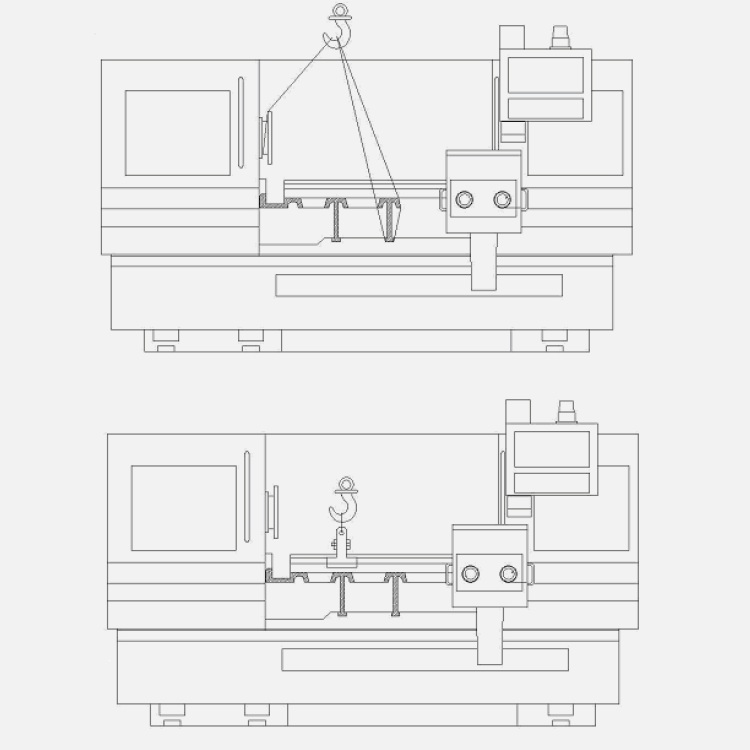
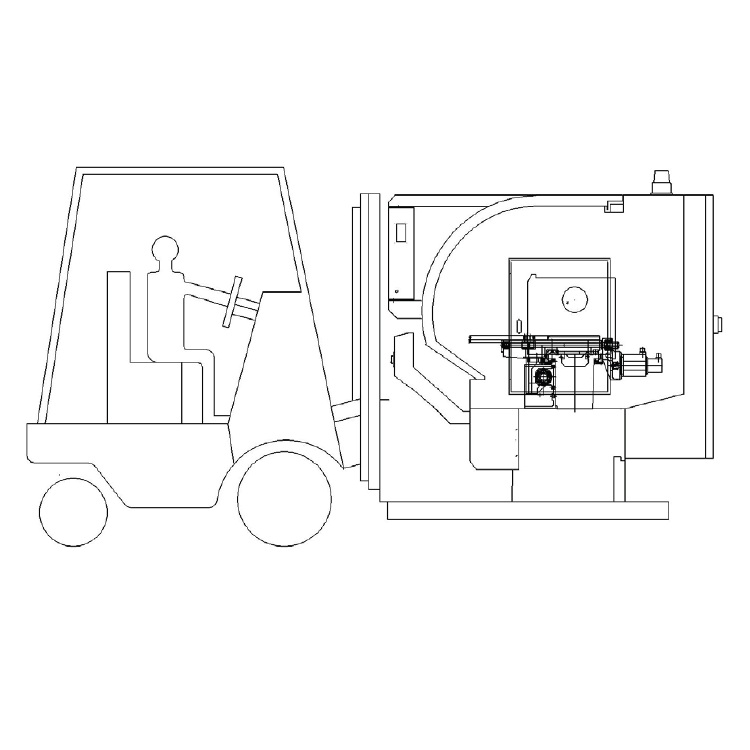
Before placing the Lathes, please fix the adjusting screws on the base, make the lathe machine as close as possible to the floor, and position the leveling pads in their most suitable place, so as to increase the stability of machine.
All protective coating must be removed before using CNC Lathe machine. Do not attempt to move any ways if the coating still exists. Be cautions while selecting a suitable cleaning agent Paraffin applied with a clean brush will soften the protective coating, The protective coating can then be removed with clean rags.
Do not use gasoline or any other flammable solution to clean the lathe machine
Clean and lubricate all the exposed ways of table and saddle. Drive the table and saddle to one end of travel. Clean and lubricate ways thoroughly then drive table and saddle to the other end and clean and lubricate ways thoroughly as well. Be sure to use a suitable lubricant.
This Procedure integrates common practices from world-famous CNC Lathe Machines' manufacturers (such as Haas, DMG MORI, Mazak) with classical metrology methods.
4.1. Initial Placement and Rough Leveling:
Place the machine on its foundation with anchor bolts loose.
Adjust the leveling mounts until the machine is roughly level and all mounts bear weight (machine is not rocking).
4.2. Reference Surface Selection:
The precision level must be placed on a critical, precision-ground surface of the lathe machine. Common locations include the spindle mounting flange, the Z-axis ways (rails), or the chuck mounting surface. Some thoughts (such as: German VDI/DGQ guidelines) likely to prioritize measuring the guideways themselves, while others focus on the work-holding surface.
4.3. Core Operation: Eliminating Twist
(4.3.1) Longitudinal Leveling (Along Z-axis):
Place the level parallel to the Z-axis guideways.
Traverse the carriage (or tailstock) along the Z-axis, stopping at multiple positions (headstock, middle, end of travel).
Critical Criterion: Observe the level's reading at each position. If the reading remains constant, the bed is free of twist longitudinally. If the reading changes, you must adjust the leveling mounts at the specific locations to bring the readings into tolerance across the entire travel. Normally, the target tolerance is often 0.02mm/1000mm or better.
(4.3.2)Transverse Leveling (Across X-axis):
Place the level perpendicular to the Z-axis (straddling the ways).
Repeat the Z-axis traverse. This is the most sensitive test for detecting bed twist.
4.4 The "Bridge Method" (Triangulation via NAVFAC P-306 Standard) :
For lathe machines with separated guideways, use a precision bridge plate across the ways to place the level.
This method averages the surfaces and provides the most accurate representation of the guideway system's twist.
Tighten the foundation bolts in a diagonal, incremental pattern using a torque wrench set to the lathe machine manufacturer's value.
After each bolt is snugged, immediately re-check the level readings. If they shift out of tolerance, loosen the bolt and re-adjust the wedge.
The goal is to lock in the geometry without introducing new stress.
(5.1) Geometric Accuracy Test :
Leveling is a means to an end. The final validation is a geometric accuracy check performed according to ISO 230-1 or ASME B5.54.
(5.2) Important Tests include :
Parallelism of the spindle axis to the Z-axis movement.
Concentricity/alignment of the tailstock quill to the spindle.
Straightness of Z-axis motion in the vertical plane.
Only passing these tests confirms the leveling for Lathes are successful.
Leveling a CNC lathe is a rigorous metrological process, the core of which is to eliminate bed distortion. Please strictly follow the lathe manufacturers' manual, use high-precision measuring tools, and ultimately rely on geometric accuracy inspections as the basis for acceptance. Any shortcuts may result in a loss of machining accuracy, abnormal bearing wear, or reduced machine life.
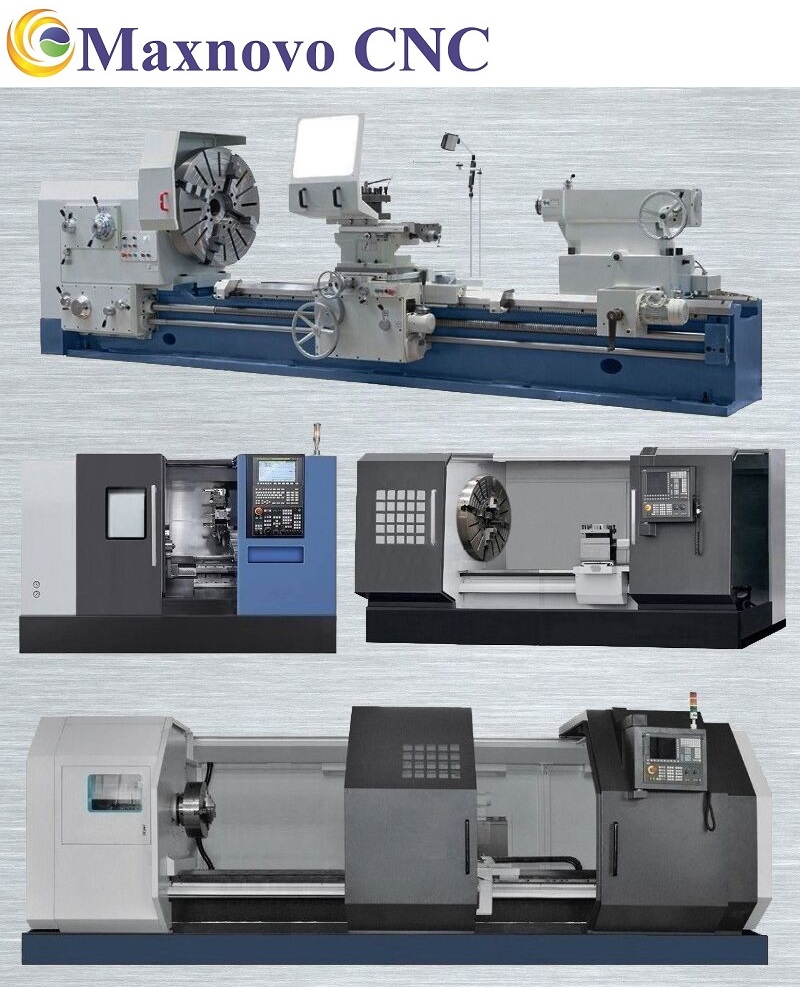
Knowing how to level a CNC Lathe or Metal lathe or is just one part of the equation.
Get the Right Lathes With MAXNOVO MACHINE.
MAXNOVO MACHINE - High Precision CNC Lathe and Metal Lathe for Demanding Users.


